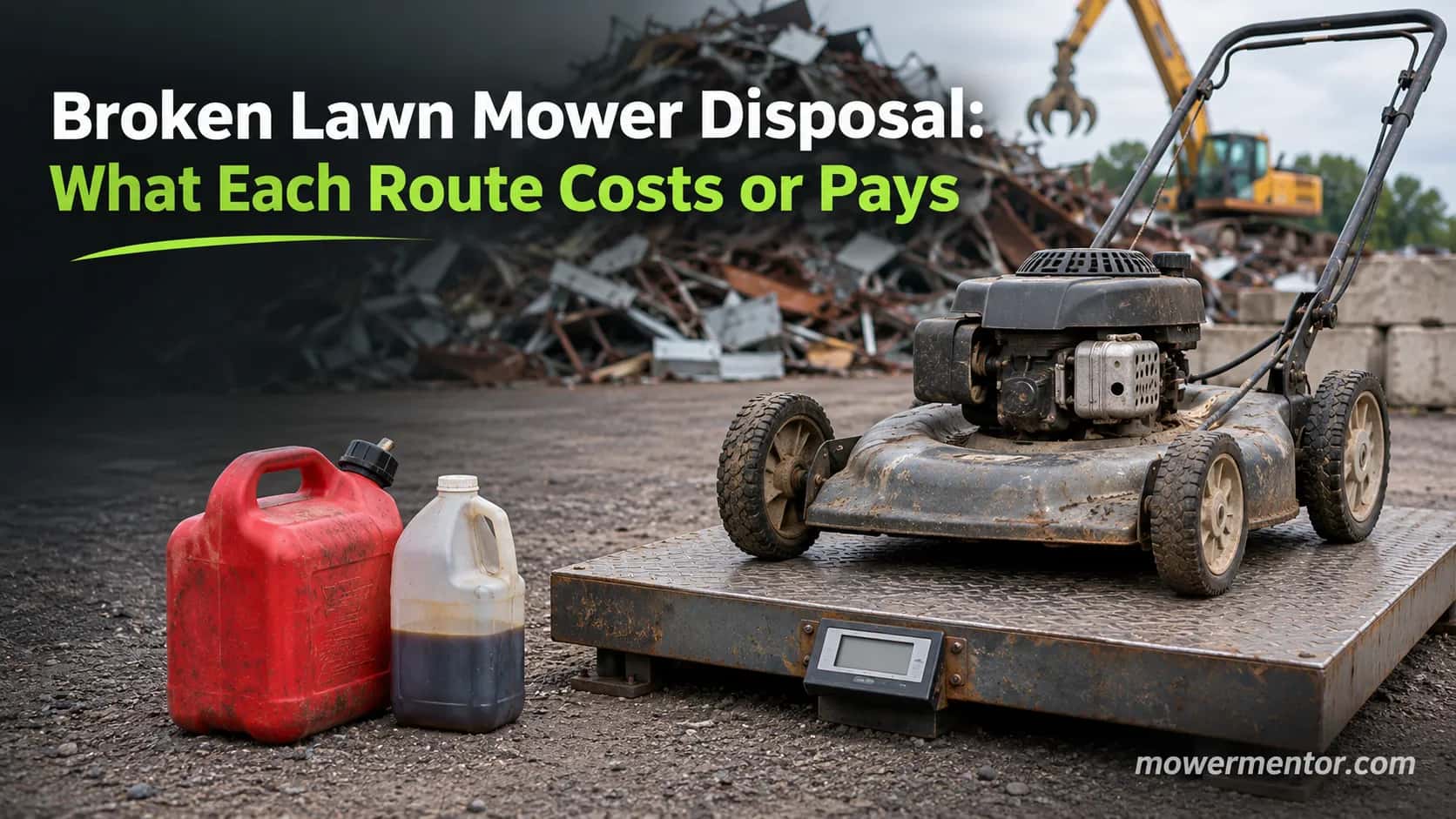
Broken lawn mower disposal can be free through city bulky pickup after draining the gas and oil; scrap yards pay about 8 cents a pound.
That scrap rate is the US and Canada light-iron average for October 2026, not one yard's quote. Getting the gas, oil and any battery out first is what opens the free and paying routes to a dead mower.
A paid junk hauler is the fallback when you can't move it; LoadUp's Tacoma, Washington, price starts at US$110. Home Depot and Lowe's collect batteries for recycling, not mowers, so a store trip only helps with the battery.
If the mower still runs or might be cheap to fix, check whether a repair is worth the money before you scrap it. Every route below is compared on cost, hauling and prep, followed by the maker's drain steps and a way to find your town's rule.
Where a broken mower can go, ranked by cost and hauling
For a dead push mower, city bulky pickup is the best route where your city runs it. It's free or already in your bill, and nobody hauls anything. A county drop-off can take it free, a scrap yard pays by weight, and a junk hauler costs the most.
The table sets the five routes side by side for one drained push mower.
Route | Takes a dead mower | Cost or payout (US$, one push mower) | Hauling needed | Prep required | Best for |
|---|---|---|---|---|---|
City bulky-item pickup | Yes, where the city's item list names mowers | Free in Kansas City; in Bloomington's monthly bulky fee | None, it goes at the curb | Gas and oil drained, appointment booked | Owners without a truck |
Scrap yard | Yes, once drained; call first | Pays by weight, see below | Pickup, SUV or trailer | Gas, oil and battery out | Owners with a truck who want money back |
Transfer station or recycling drop-off | Yes, as scrap metal | Free in Montgomery County, Maryland, with proof of residency | You drive it there | Gas and oil drained | Owners near a county facility |
Giving it away or selling it for parts | Yes, if listed as not running | Free to list | The taker collects it | An honest listing | Owners with time to wait |
Junk removal pickup | Yes | From 110 at LoadUp in Tacoma; others quote on site | None, the crew lifts it | Gas, oil and battery out | Owners who can't lift or haul it |
Prices checked October 2026. The costs and rules come from Kansas City, Bloomington, Montgomery County, iScrap App and LoadUp, each linked in its route below.
Start with whether it runs: a mower that starts belongs with a buyer or a donation. For a dead one, ask whether you can haul it and whether you want money back or zero effort.
A pickup or SUV opens the scrap yard and the drop-off; with no vehicle, it's the curb or a hauler. A riding mower changes the hauling, so it has its own section further down.
City bulky-item pickup
City bulky pickup is the free route for a dead mower and the top pick for anyone without a truck. Kansas City's bulky collection is free and by appointment for single-family homes and apartments of 6 units or fewer.
Its rule for a mower is short: drain all fuel and oil. Bloomington, Minnesota, makes no extra charge at pickup, because a monthly bulky-item fee on the residential utility bill covers it.
The weak spot is coverage. The service exists only where a city runs it, you book ahead, and a mower still holding gas or oil stays at the curb.
My own county's program takes a drained mower by appointment at no extra charge.
Scrap yard
Scrap yards do take old lawn mowers once they're drained, as 1-800-GOT-JUNK's disposal page notes, and they pay by weight. That puts them second, and first for owners with a truck who want money back.
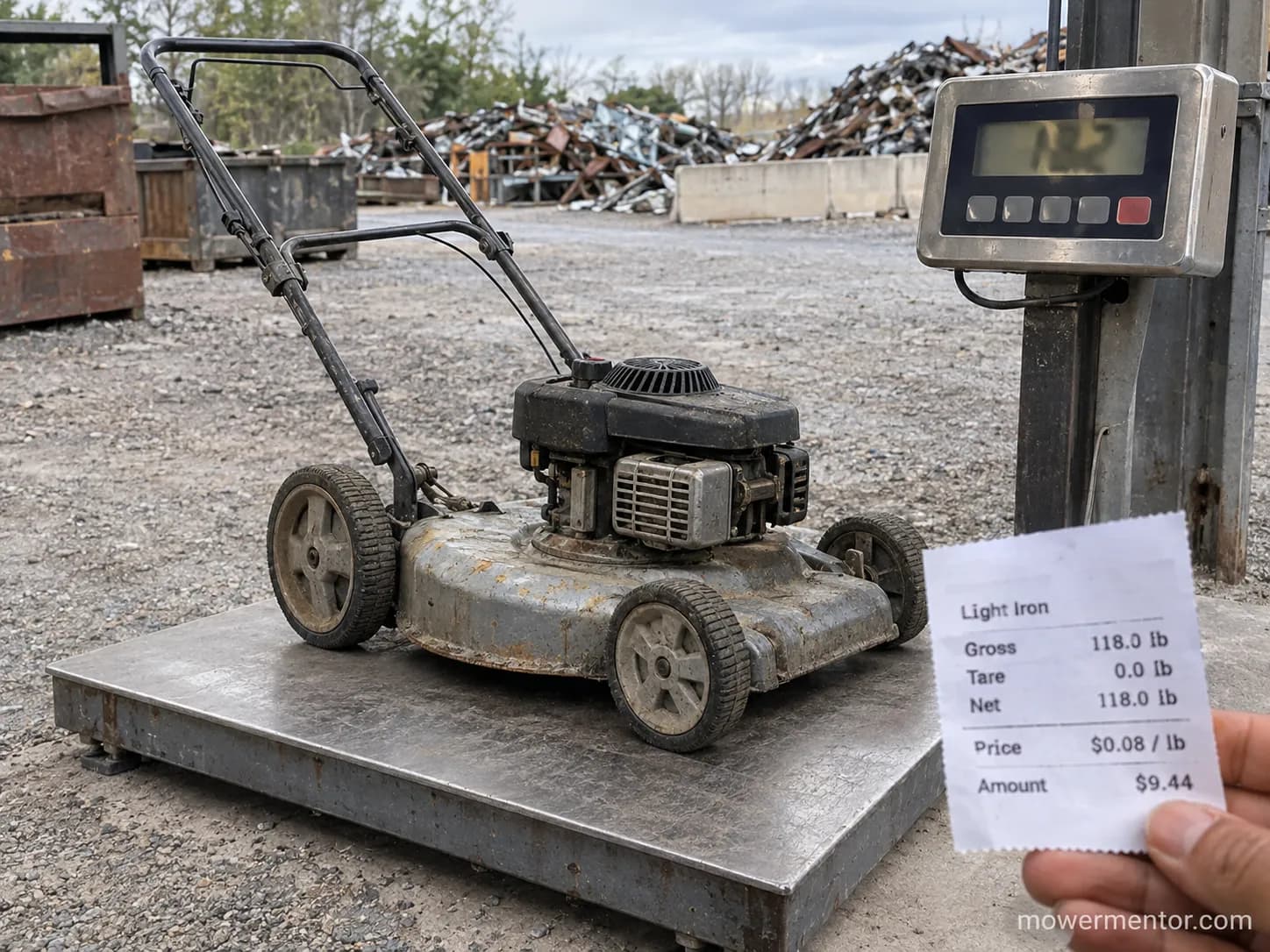
Yards buy a mower as light iron, which iScrap App's light-iron price page describes as appliances and other thin-gauge steel. Grade names vary by yard, so ask which grade a mower falls under.
On October 15, 2026, iScrap App put the US and Canada light-iron average at US$168.19 a ton, about 8 cents a pound. Single yards posted 6 cents a pound in Hanover, Pennsylvania, and 8 cents in Bloomington, California, earlier that month.
A steel deck like the Toro 21352's is that kind of thin steel. I took my drained Toro 21352 to a yard because I had my pickup and wanted something back.
The yard's slip came to a few dollars:
Weigh-in at the yard | My mower |
|---|---|
Mower weight on the yard scale (lb) | About 60 |
Rate paid (US$ per lb) | 0.07 |
Payout (US$) | About 4 |
That's the honest limit of scrapping: at cents a pound, a trip nets pocket money, not a payday. Each yard also sets its own acceptance rules, so call first and ask whether it takes a drained mower.
Transfer station or recycling drop-off
A county transfer station can take the mower free when you can haul it yourself. It comes third and suits owners who live near one. Montgomery County, Maryland's transfer station takes large scrap metal at its drop-off area at no charge.
Residential users must show proof of county residency. Bloomington's yearly recycling drop-off event for residents also takes lawnmowers as free scrap metal once the oil and gas are out. You do the driving and unloading, around the facility's hours and residency rule.
In my county, the transfer station's scrap-metal drop-off is free with proof of residency.
Giving it away or selling it for parts
A free listing marked "not running" or "for parts" can clear a dead mower at no cost. That makes it a fourth-place route for owners with time to wait, since no-shows and slow replies come with free.
For what a broken mower is worth in parts, see the repair guide linked at the top.
Junk removal pickup
A junk hauler ranks last because it always costs money, but it's the route for owners who can't lift or haul the mower. LoadUp's lawn mower removal page for Tacoma, Washington, starts the price at US$110.
The total depends on the mower type, how many you have and where you live.
The two big franchises quote in person instead.
1-800-GOT-JUNK charges by the space your items take in the truck and gives an exact price only on site. It does offer same-day appointments.
Junk King also quotes by volume and takes US$30 off for booking online at participating locations.
Paying doesn't skip the prep: 1-800-GOT-JUNK asks for the fuel and motor oil to be completely emptied first.
LoadUp's online price for my push mower matched its listed starting price. The order weighs what one drained push mower costs or pays against the hauling each route needs.
A free curb pickup beats a few dollars that take a truck to earn. After that, it favors routes that reliably take a mower that doesn't run.
The free routes depend on a city or county running them, and the examples come from a handful of programs.
The scrap rate is a US and Canada average that changes often, and the weigh-in covers one push mower in one county.
Will Home Depot or Lowe's take your old mower?
No: neither store's in-store recycling program takes an old mower. Both collect batteries, not machines, so a store only helps with your mower's battery.
Home Depot's battery recycling page says every store has a recycling station at the entrance for batteries, CFL bulbs and plastic shopping bags.
At Home Depot, then, the pack goes in the bin and the mower goes elsewhere. The bin's limits are in the battery section further down.
The Lowe's in Worcester, Massachusetts, hosts a collection point of The Battery Network, the program formerly called Call2Recycle.
Massachusetts' state recycling listing says that point accepts rechargeable batteries only.
Neither page mentions a mower trade-in, so confirm any advertised trade-in in person before you load the mower.
I asked at one Home Depot and one Lowe's. Staff at both said the store doesn't take an old mower and pointed me to the battery recycling bin by the entrance.
Use a route from the table above instead. Buying a new riding mower with delivery? Ask the delivery desk in writing whether the old one can leave on the same truck.
Getting a dead riding mower hauled or scrapped
A dead riding mower takes the same routes once it's drained, but moving it is the hard part.
That's why a junk hauler earns its fee more often here. LoadUp says its price varies from a lightweight push mower to a bulky riding mower, so expect more than its starting price.
The prep adds one job: the lead-acid starting battery comes out, and there's more gas and oil to drain.
These routes take a rider:
City bulky pickup, where the item list names lawn mowers and the rider fits the weight cap (Kansas City's is under 500 lb).
A county drop-off for large scrap metal, such as Montgomery County's.
A scrap yard, if you can get the mower onto its scale.
Junk removal, priced by the truck space a rider fills.
If a hauler takes it, the crew does the lifting. On your own trailer, follow the transport section of your mower's operator's manual.
At the yard, a rider's extra steel earns more at the same per-pound rate as a push mower.
Drain the gas and oil before any route
Bulky pickup, drop-offs, scrap yards and haulers all want the gas and oil out first. Use a hand fuel pump or run the tank dry, never a siphon, then tip the mower air-filter side up to drain the oil.
You need a hand fuel pump, an approved gas can, a drain pan, a leak-proof oil container, gloves, a block of wood and a socket wrench.
If you need a pump, AutoZone sells a SureBilt hand pump for gasoline at US$6.99; the rest are garage basics. It's a beginner job.
If you don't have a spare can for the fuel, the No-Spill 1405 gas can fits step 3. No-Spill's own page prices it at US$32.99.
The 2.5-gallon can is California Air Resources Board compliant and child resistant. It has a Flame Mitigation Device, an automatic flow stop to help prevent spills and a 3-year warranty.
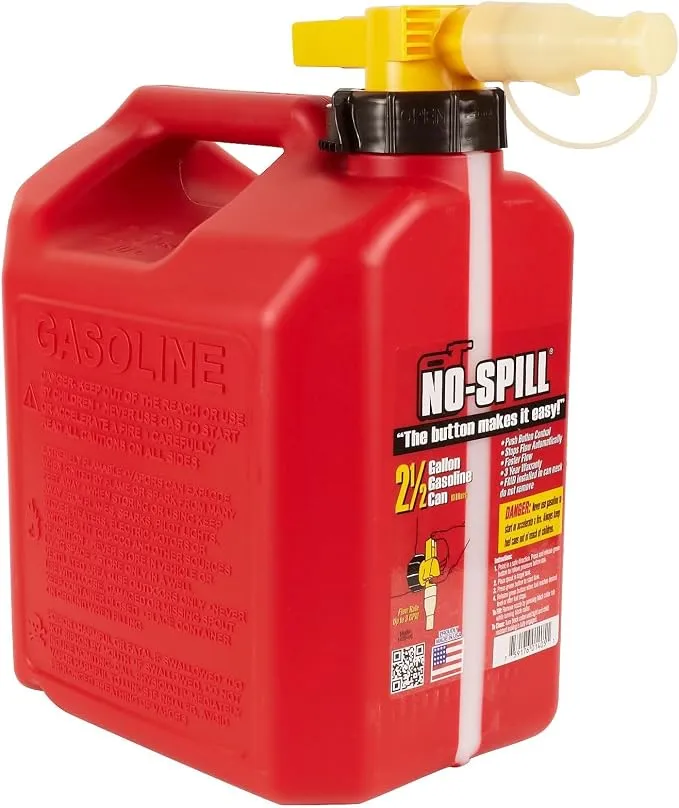
by No-Spill
A 2.5-gallon gasoline can for the fuel pumped out of a mower before disposal. No-Spill lists it as CARB compliant and child resistant, with a Flame Mitigation Device and an automatic flow stop.
Check Price (opens in a new tab)In Stock · Amazon
Pros
- CARB compliant and child resistant, as No-Spill lists it
- Comes with a Flame Mitigation Device installed
- Automatic flow stop helps prevent spills
Cons
- The push button takes a firm, steady press to pour, harder with gloves on
- At 2.5 gallons, it is a lot of can for the little gas a push mower's tank holds
As an Amazon Associate, Mower Mentor earns from qualifying purchases.
Warning: Gasoline is extremely flammable and explosive, and tipping a mower with fuel in the tank can make it leak.
Shut the engine off, let it cool and pull the spark-plug wire before you start. Never siphon the fuel.
These warnings come from Toro's 2018 operator's manual for its 21-inch Recycler models 21332 and 21352.
The steps follow the same manual, written for a walk-behind mower with no oil drain plug; a riding mower drains by its own manual.
If the engine still runs, you can run the tank dry first and skip step 3:
Move the mower outdoors onto a level surface, with the engine off and cold.
Pull the spark-plug wire off the spark plug.
Pump the fuel into an approved gas can with a hand pump.
Remove the dipstick from the oil-fill tube.
Tip the mower onto its side with the air filter up, so the oil drains out of the oil-fill tube into the pan. It's done when oil stops dripping from the tube.
Pour the oil from the pan into a leak-proof container.
Optional: If your yard or pickup wants the blade off, remove it with gloves on and a block of wood holding it steady. The blade is sharp and can cause serious injury.
On my dead Toro 21352, the hand pump emptied the tank into the can. The oil ran out of the fill tube once the mower lay on its side, air filter up.
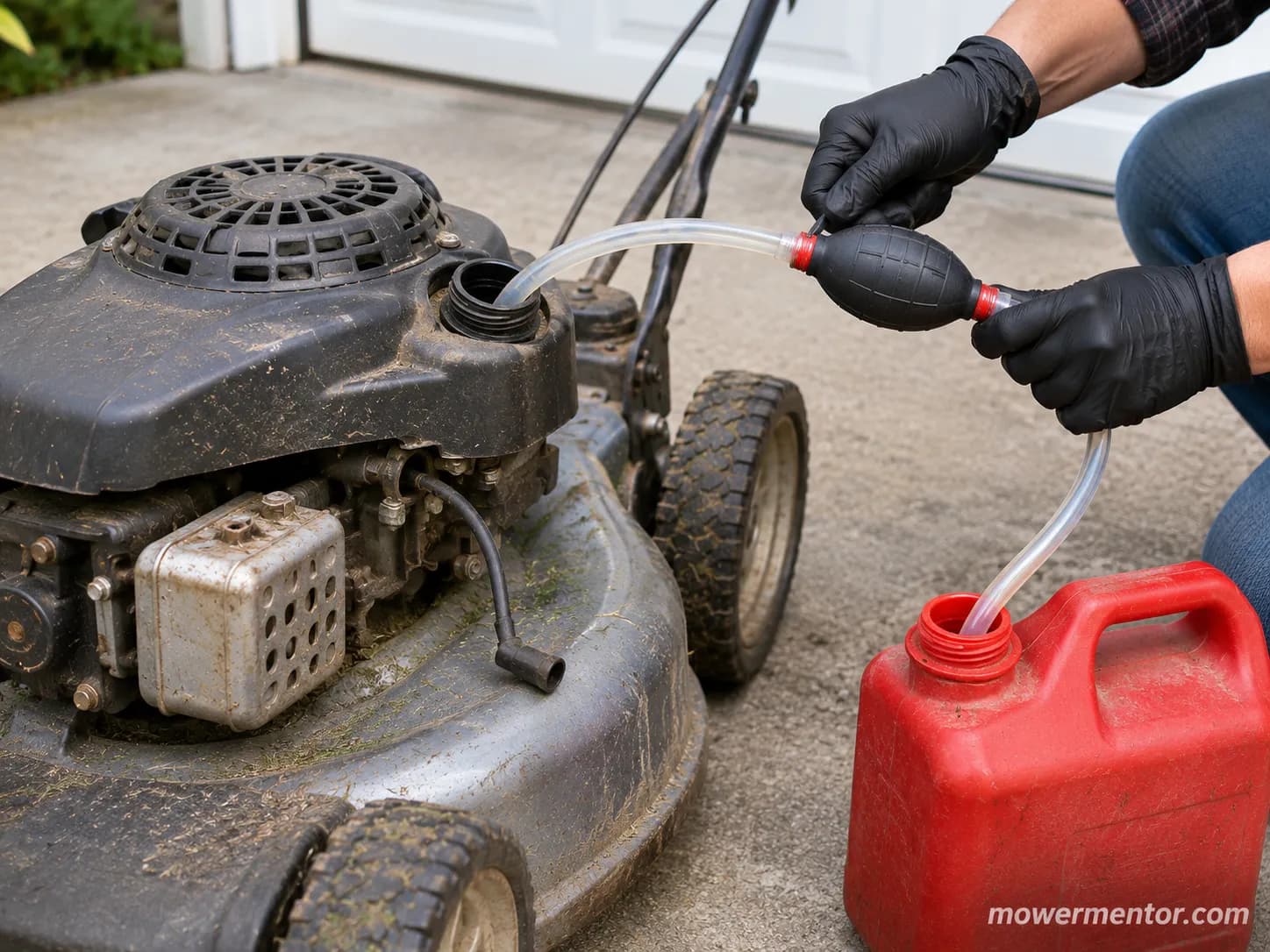
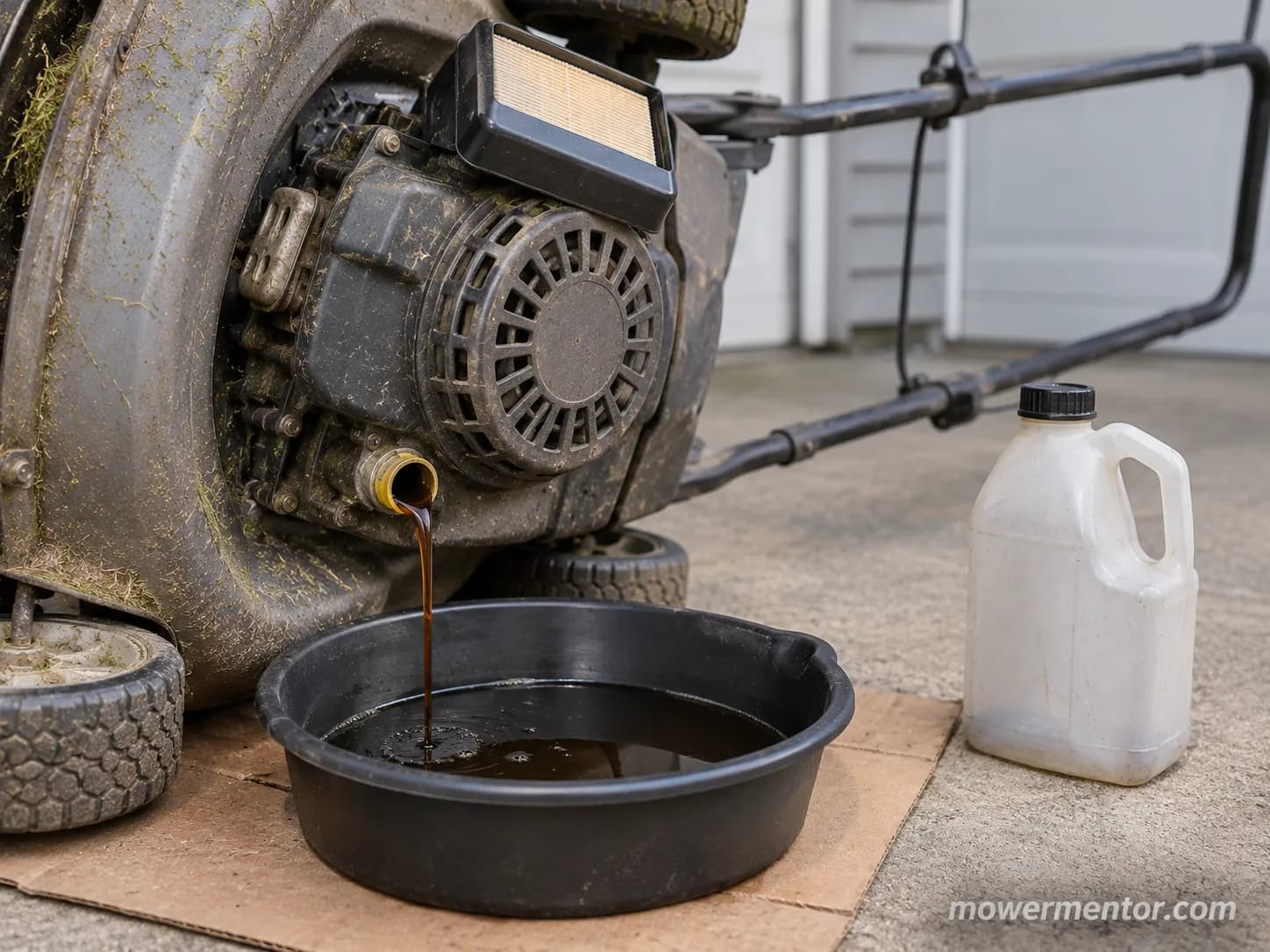
Avoid two mistakes: tipping the mower with gas still in the tank, which can make fuel leak, and tipping it with the air filter facing down.
Keep the air filter up every time. Cap the gas for a household hazardous waste site, which is where Los Angeles County Public Works sends a mower's gasoline.
The oil can go with it: Alameda County's StopWaste program says to capture and cap both fluids for the hazardous waste facility.
A used-oil collection point also takes the oil. The EPA's used-oil page says to ask local garages, waste collectors and officials where to drop it off.
Never pour it out: oil from one oil change can contaminate a million gallons of fresh water. Some county drop-offs take both fluids, as Montgomery County's takes motor oil and residents' hazardous waste at no charge.
One hauler's advice clashes with the maker on the fuel. 1-800-GOT-JUNK calls a siphon pump the safest way to drain old fuel. Toro's manual says to use a hand pump or run the engine dry, and never to siphon.
Follow the manual, since it's the maker's own instruction for this mower.
Pull the battery from an electric or riding mower
Take the battery out before any route, tape its terminals and drop it in a store recycling bin. Home Depot's bins take rechargeable packs up to 11 pounds and under 300 watt hours, free.
Haulers ask for this too, as 1-800-GOT-JUNK wants the battery pack removed before the appointment. The Battery Network, formerly Call2Recycle, warns never to put rechargeable batteries in household trash or recycling.
Three steps get a pack into a bin:
Remove the battery pack from the mower.
Bag the pack, or tape its positive terminal with clear packing tape, electrical tape or duct tape.
Drop it in the battery recycling bin at a Home Depot entrance.
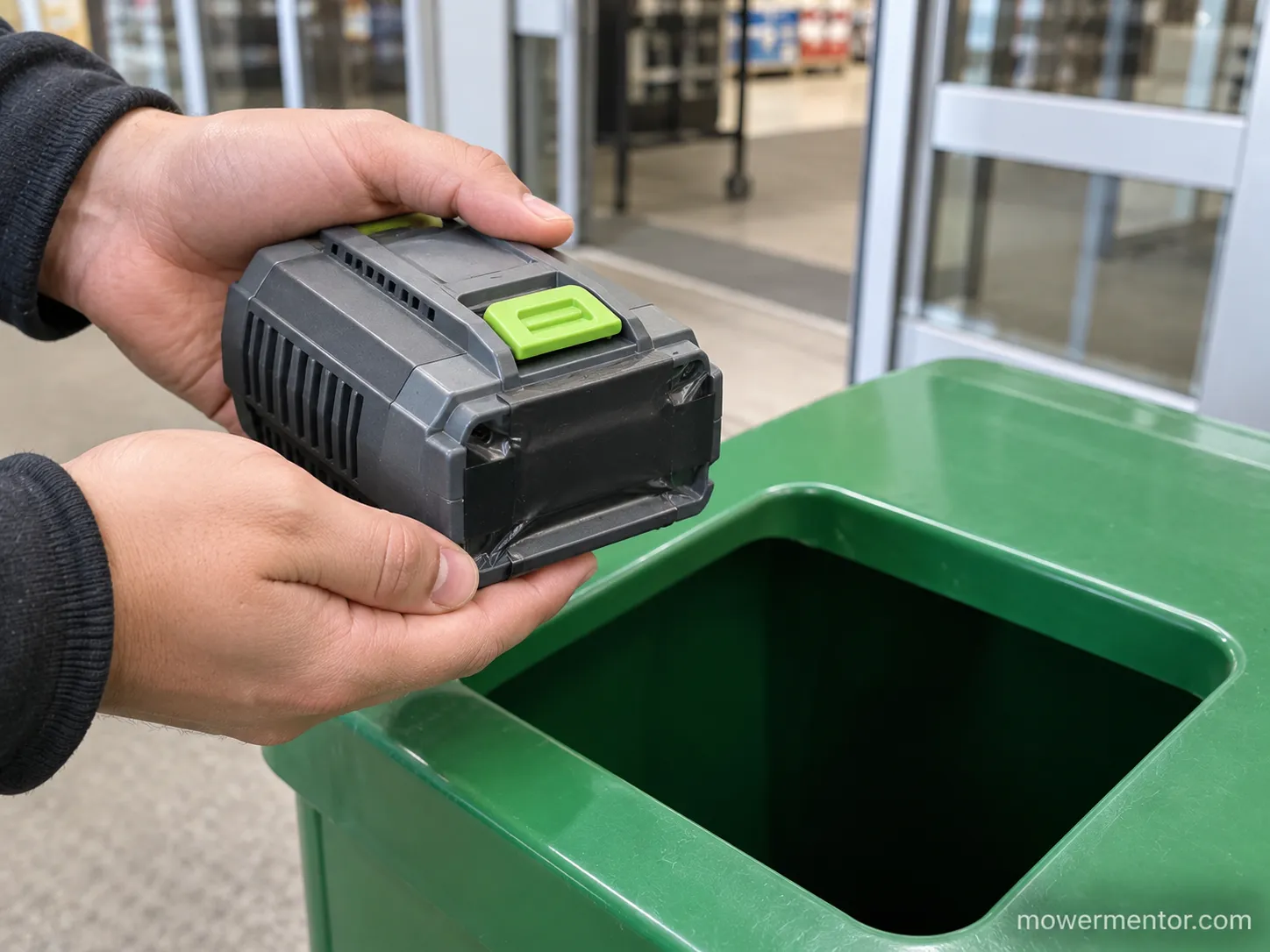
Small sealed lead-acid batteries go in the same bins, and only non-leaking batteries are accepted. Watt hours are the volts times the amp-hours on the pack's label, so a 56V pack above about 5.3Ah is over the limit.
A pack over either limit, or a leaking one, can't go in that bin. Tape or bag it and ask your county's household hazardous waste site; Montgomery County's drop-off, for one, takes rechargeable batteries from residents.
A riding mower's starting battery is lead-acid. It can go to Home Depot, which also lists auto and tractor batteries, or to a county drop-off that takes lead-acid, like Montgomery County's.
Once the pack is out, a battery mower's body goes the same way as a gas mower's.
That means bulky pickup or scrap metal, from the table above, with the pack in the bin.
Find your town's rule for a dead mower
Look up your city or county with "bulky item pickup", then with "household hazardous waste".
Those two pages decide whether a drained mower goes free at the curb and where the gas and oil go. Five lookups cover the rest:
Find your city's bulky or large-item pickup page, or call your trash hauler, as Los Angeles County tells residents to do.
Look up "lawn mower" in the item list or item search; StopWaste's directory, for one, lists curbside pickup for a non-working mower only when it's free of gasoline and oil.
Find the household hazardous waste site or event for the gas and oil; WM's At Your Door service collects motor oil at home in some communities.
Check your county transfer station's accepted items and residency rule, such as Montgomery County's proof of residency.
Call one scrap yard and ask whether it takes drained mowers and what it pays for light iron.
Draining comes first because the curb, the drop-off, the yard and the hauler all ask for it, and a hauler only earns its fee when you can't move the mower.
Pick the route that fits your vehicle and patience, drain the mower the maker's way, then book the pickup or the trip.