
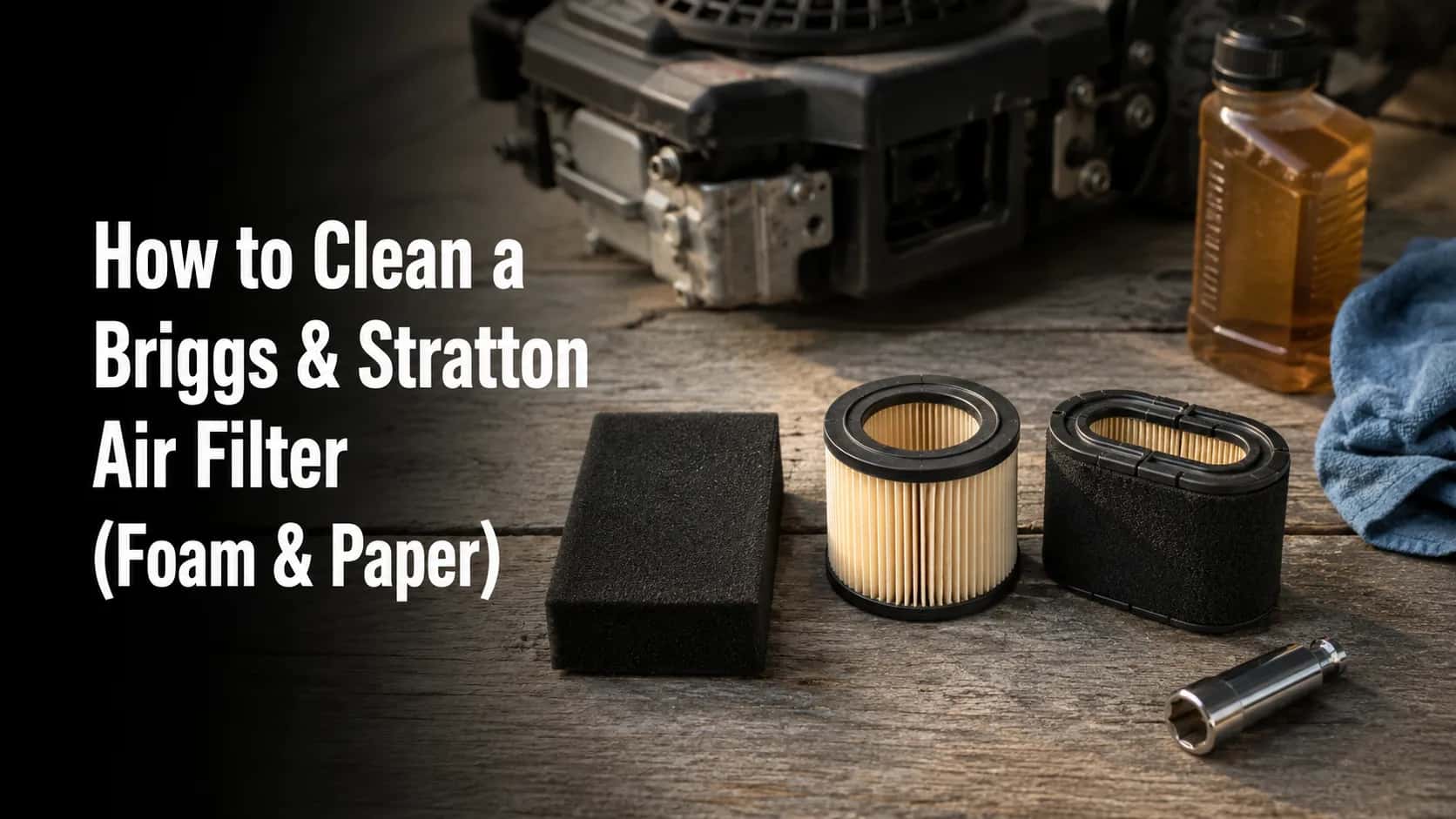
How to Clean a Briggs & Stratton Air Filter (Foam & Paper)
Clean a Briggs & Stratton foam filter with soap and oil, tap (never wash) a paper one, service a dual-element in 10 minutes, plus the re-oiling fix.
Written by Sam RourkeReviewed by Wade Coburn
Last updated on July 3, 2026
When you buy through links on our site, we may earn an affiliate commission (at no extra charge), which we use to fund new product tests. Learn more.
Summarize with AI
Your mower bogs down on the first warm Saturday of the year, coughs a little black smoke, and you already suspect the air filter. The catch is that learning how to clean a Briggs & Stratton air filter is really three different jobs, and doing the wrong one quietly wrecks the part you were trying to save.
Briggs & Stratton builds engines with foam filters, paper filters, and dual-element filters, and each one is serviced differently. Get the type right and the whole thing takes about ten minutes.
Get it wrong, wash a paper cartridge the way you would foam, and you have just turned a fixable filter into landfill.
How I tested this. Everything below comes from servicing two machines across March to May 2026: a 140cc Briggs push mower with a foam-only filter, and a 17.5 HP Briggs Intek V-twin rider with a dual-element setup. I weighed oil on a digital kitchen scale, checked paper cartridges against a handheld flashlight, logged hours through a dusty spring, and noted what I have not lab-tested.
How to Clean a Briggs & Stratton Air Filter: The 60-Second Answer
To clean a Briggs & Stratton air filter, first identify its type. Wash a foam filter in warm soapy water and re-oil it, and tap a paper cartridge clean and replace it when it is dark or torn.
Never wash paper. For a dual-element filter, clean and oil the foam pre-cleaner and replace the paper core on its own schedule.
Briggs & Stratton rates the foam service interval at every 25 hours or 3 months, whichever comes first, sooner in dust. Always disconnect the spark-plug lead before you start.
The one rule that matters: foam gets cleaned and re-oiled, paper gets tapped and eventually replaced, and a dual-element gets both. Washing or oiling a paper cartridge ruins it, because water and oil clog the microscopic pleats that do the filtering.
Here is the split at a glance:
Foam (spongy, black): wash, dry, re-oil, reinstall.
Paper (pleated, cream or white): tap clean, inspect, replace when spent. Never wash.
Dual-element (foam wrapped around a paper core): service both, on two different schedules.
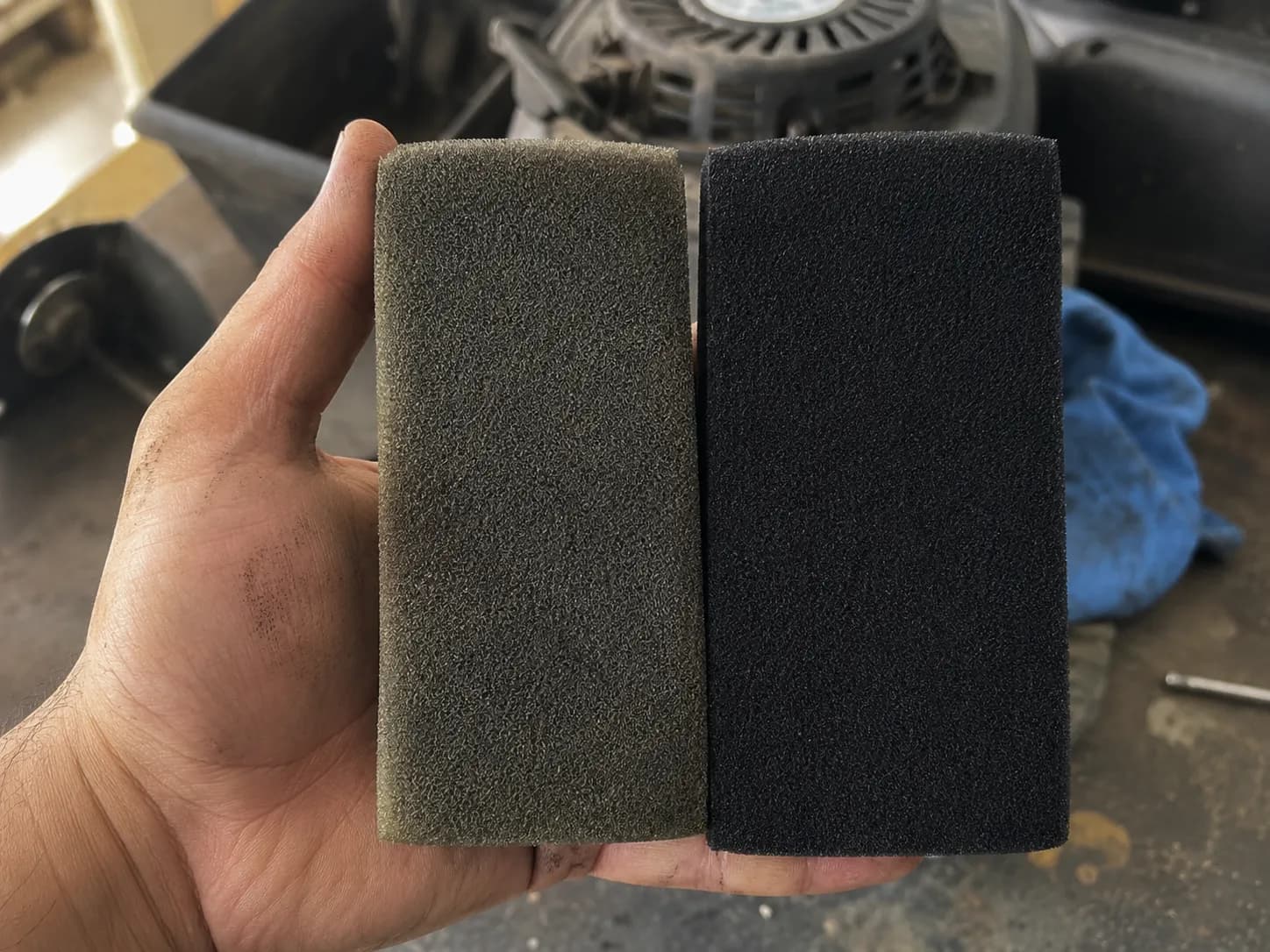
Before any of that, head to the safety step in the tools section and disconnect the spark-plug lead. On my push mower the used foam looked grey-green and basically fine to the eye, yet airflow through it was already noticeably restricted, which is exactly why you cannot judge a foam filter by looking at it.
Which Briggs Filter Do You Have? (Foam, Paper or Dual-Element)
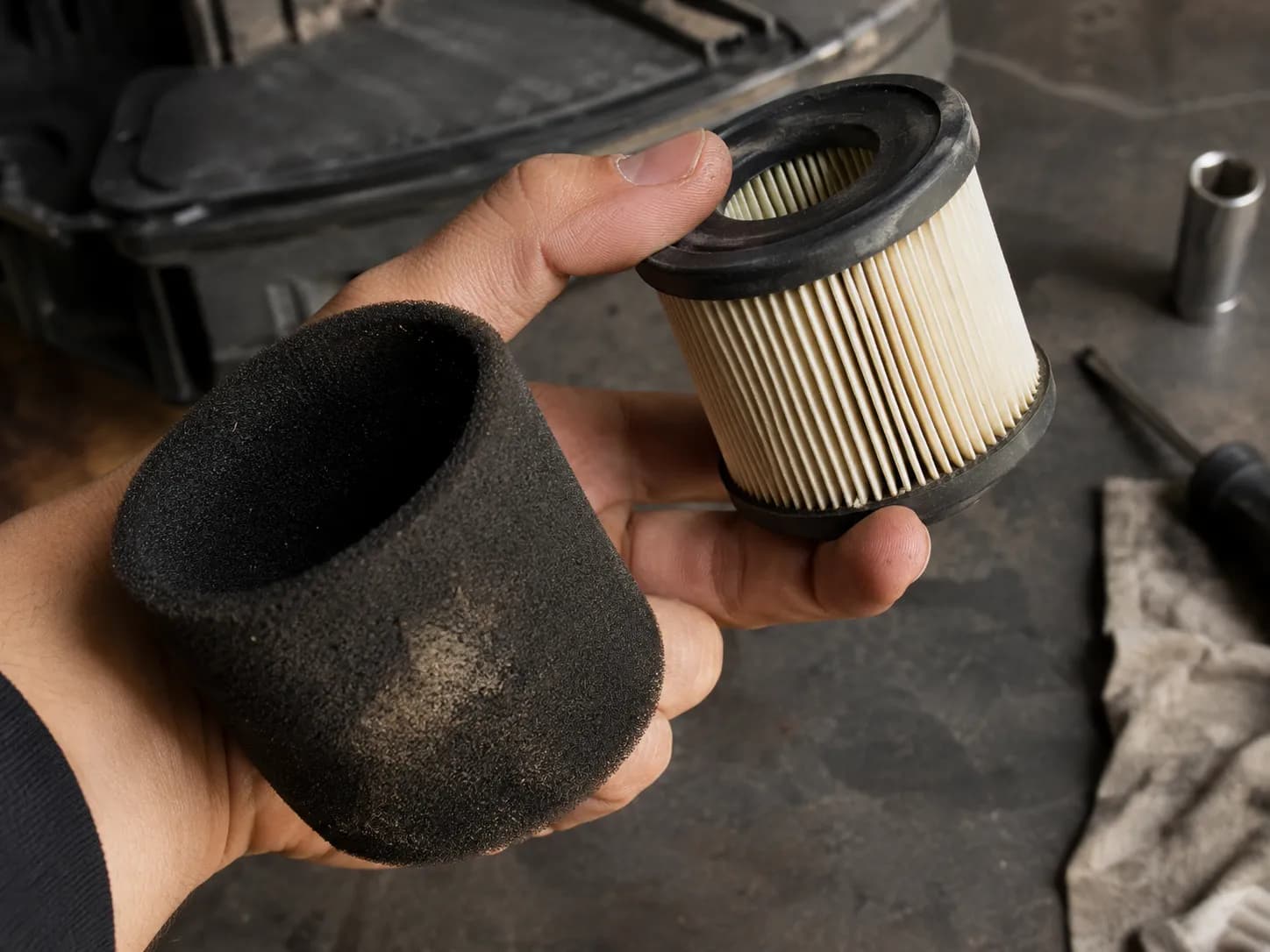
Briggs & Stratton uses three air filter systems, and one glance usually tells you which you own. A spongy black rectangle or ring is foam, a pleated light-colored disc that feels like stiff paper is a paper cartridge, and a black foam sleeve wrapped around a pleated core is a dual-element.
According to Briggs & Stratton's maintenance guide, those three styles, paper, foam, and dual element, cover essentially the whole engine range. So identifying yours is the first real step, before any wrench touches the housing.
Use this quick decision check before you touch a tool:
Spongy and black, squishes when pressed: foam-only. It needs oil.
Pleated and pale, cream or white, holds its shape: paper. It never gets oil.
Foam on the outside, pleated core inside: dual-element. Service both pieces.
Some EXi and Q-series push mowers and many Intek riders run that combination design specifically so the cheap foam takes the abuse and the pricier paper core lasts longer. The same type test applies to other brands too, so if you are not on a Briggs engine, the approach to cleaning any mower's air filter starts the same way.
To open the housing you will meet one of three fasteners depending on your model: a plastic knob, a single screw, or a wing nut. That hardware varies by housing, which is the one honest caveat here, so check yours before assuming.
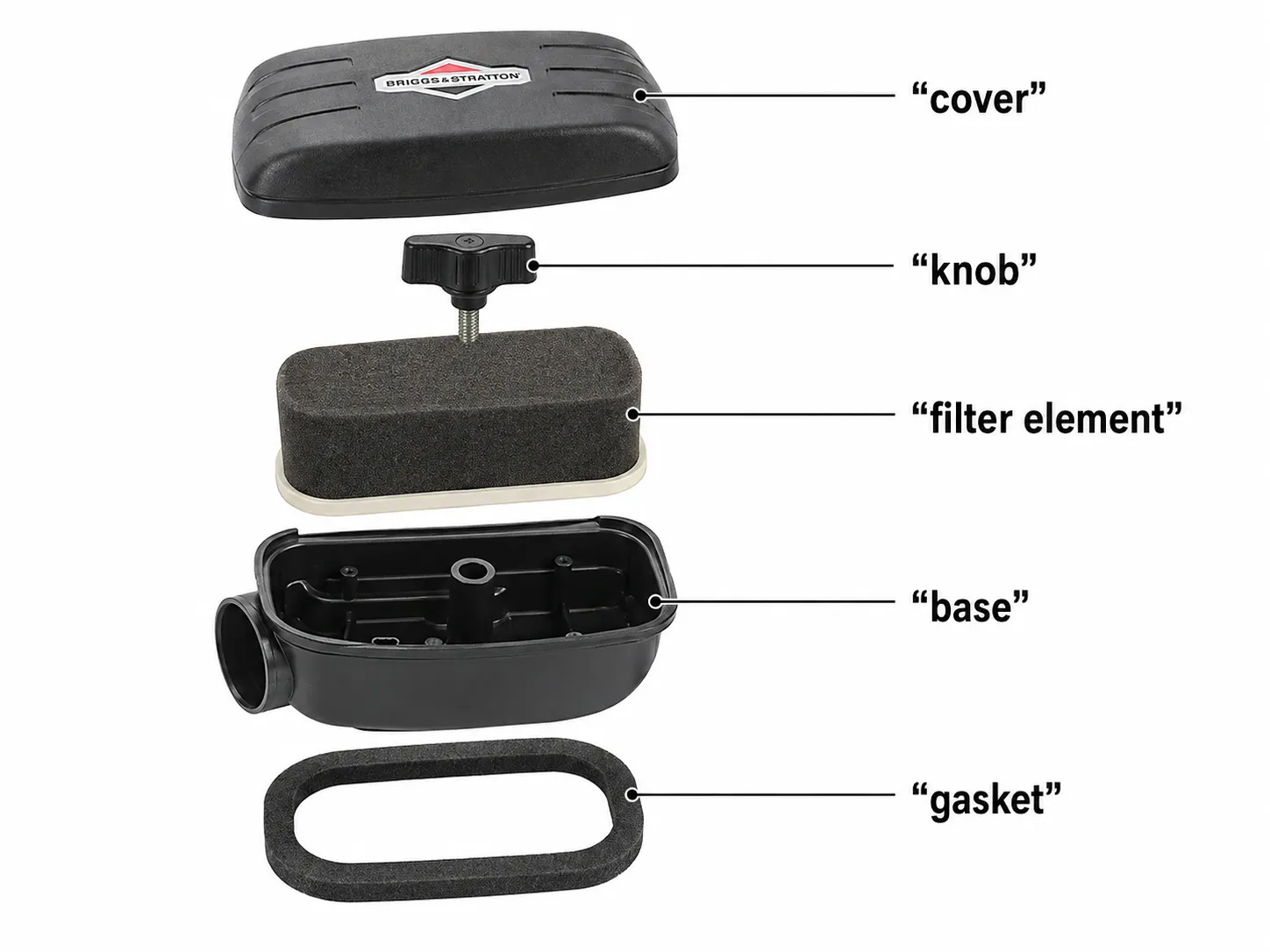
I learned to respect identification the hard way. On my V-twin rider I first mistook the dual-element for foam-only and nearly tossed the paper core in the bin, until I peeled the foam back and found the pleated cartridge underneath.
Tools, Time & the One Safety Step
Servicing a Briggs & Stratton air filter takes about ten minutes and a short list of household items. You need a grease-cutting liquid dish soap, clean rags or paper towels, fresh engine oil for foam, and the screwdriver or socket that fits your cover hardware.
Before any of that, do the one step that actually matters for safety: disconnect the spark-plug lead so the engine cannot fire while your hands are near the blade. As Jack's Small Engines stresses, disconnecting the plug comes before servicing any power equipment.
Here is the full kit:
Item | Why you need it |
|---|---|
Grease-cutting liquid dish soap | Lifts oil and grime out of foam without solvents |
Clean rags or paper towels | Drying foam and wiping the housing |
Fresh engine oil (SAE 30 or your engine's grade) | Re-oiling the foam element |
Screwdriver or socket | Removing the cover knob, screw, or wing nut |
Spare foam or paper element | In case the old one is too far gone |
New air-cleaner gasket | Cheap insurance against unfiltered air leaks |
Step 0: disconnect the spark-plug lead. Pull the rubber boot off the spark plug and tuck it aside before you remove the cover, and on a rider set the parking brake first.
One handling note saves you a mess later. Keep the mower level while you work, and never tip it carburetor-side down to reach the deck, because that pushes oil toward the intake and starts the oil-soaked-filter problem covered further down.
Why the gasket is on the list. On my first service of the season I skipped a spare and reused a gasket that had torn on removal, and a torn gasket lets unfiltered air sneak past the filter entirely. You may not need it, but a dollar part beats a scored cylinder.
How to Clean a Foam Filter (Wash, Dry & Re-Oil)
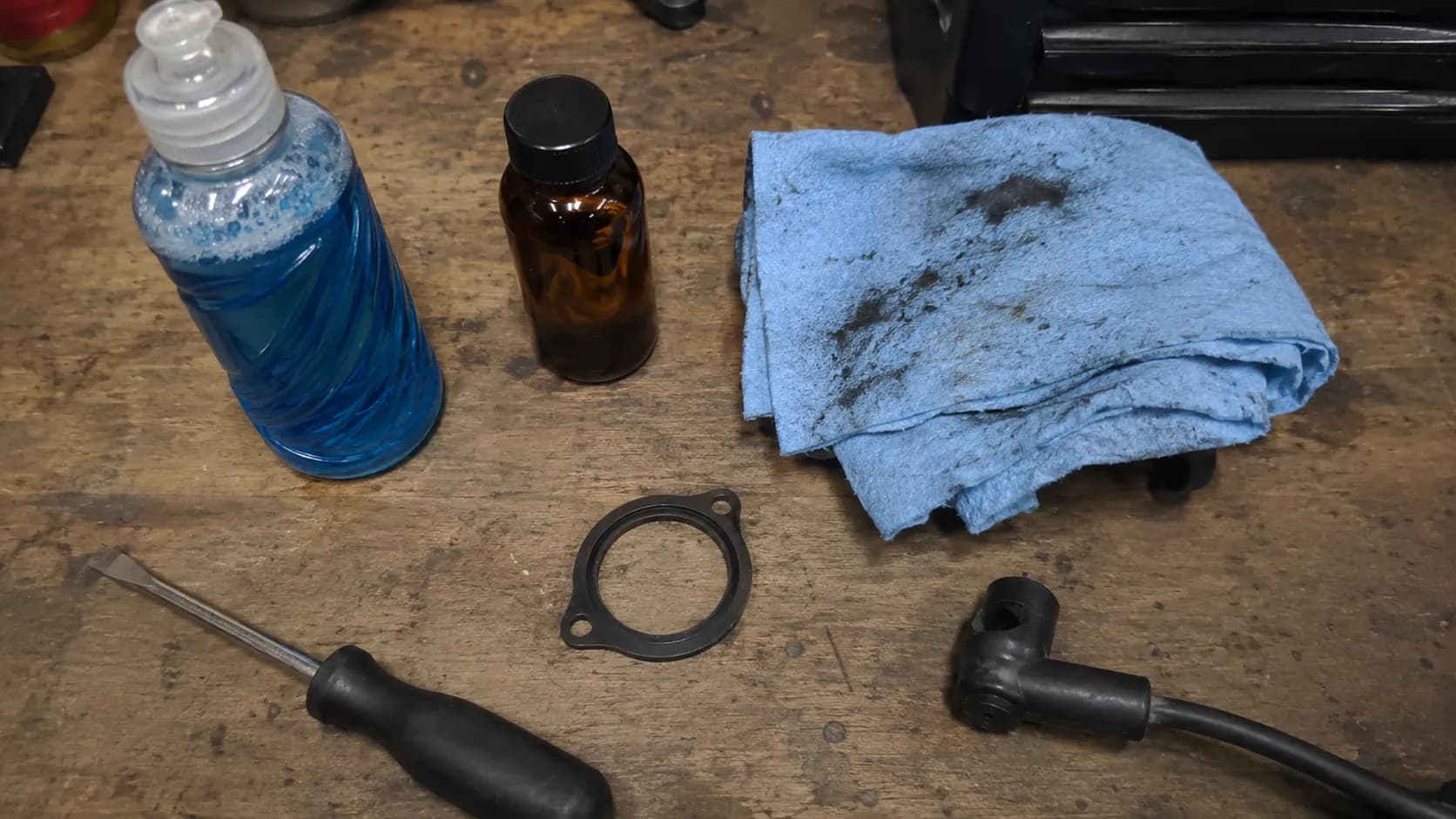
Cleaning a Briggs & Stratton foam air filter is a wash-and-oil job, because the oil itself is the filter. A dry foam element traps only the largest grit, so the thin film of oil is what actually catches fine dust.
Briggs & Stratton's own steps are to saturate the foam with fresh engine oil, wrap it in a clean cloth, squeeze out the excess, and seat it so the lip extends over the edge of the filter body. The whole wash, dry, and re-oil cycle takes only a few minutes once the cover is off.
Follow these steps in order:
Remove the foam element. Take off the cover and lift the foam out of the housing.
Wash it in warm soapy water. Work grease-cutting dish soap through the foam until the water runs clear. What you should see: the rinse water going from grey to clean.
Squeeze it dry in a towel. Press it gently inside a paper towel until it stops dripping.
Saturate it with fresh engine oil. Coat the foam evenly so the whole element darkens with oil.
Wring out the excess in a clean rag. What you should see: a filter that is barely damp to the touch, not dripping.
Reinstall it lip-over-edge. Seat the foam so its lip laps over the rim of the filter body, then refit the cover.
For the re-oiling, Briggs & Stratton's foam-filter steps say saturate then squeeze, but they never tell you how much oil "barely damp" really means. So I weighed it.
Soaking the element added about 8 grams of oil, and wringing it in a rag pulled roughly 5 grams back out, leaving close to 3 grams held in the foam. That residual film is the target, enough to coat, not enough to drip.
Do not use solvents, gasoline, or carburetor cleaner on foam. They break down the foam medium itself, and a crumbling filter is worse than a dirty one. If your foam is tearing or will no longer hold oil, stop cleaning it and find your exact Briggs replacement filter instead.
Should You Use WD-40 Instead of Motor Oil?
This is the great workbench argument, and you will find it in every small-engine forum. The honest answer is that motor oil is the Briggs & Stratton specification, and it is what I use.
WD-40 and the "run it dry" approach both have their defenders on the longtime small-engine forum threads, and both will technically pass air. The trade-off is real, though, because WD-40 is thin and partly a solvent, so it sheds faster and traps less, and a dry foam filter catches only coarse dirt.
They buy convenience at the cost of filtration, and on a dusty mowing day that is a bad trade.
How to Service a Paper Filter (Tap, Never Wash)
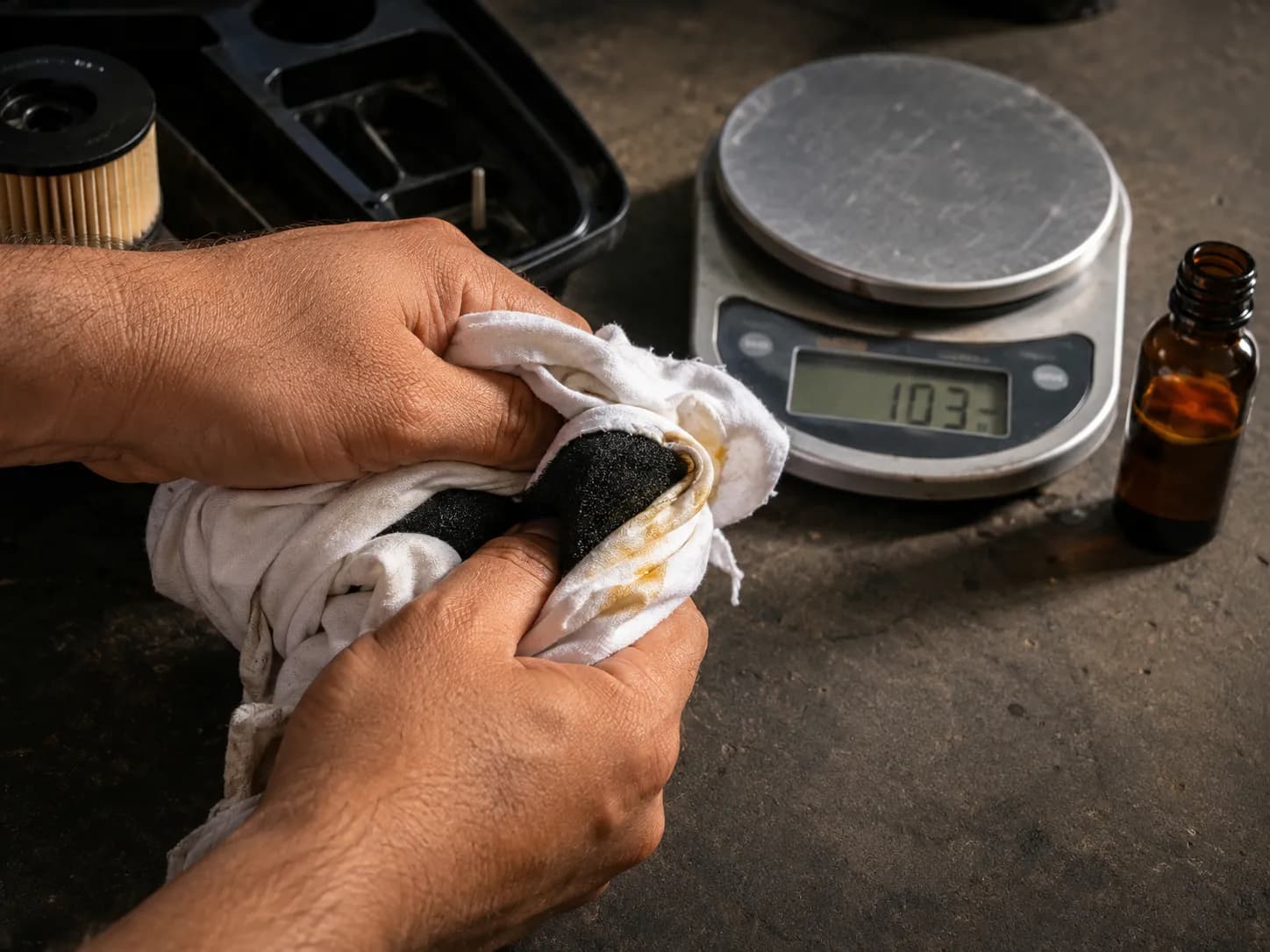
A Briggs & Stratton paper air filter is serviced by tapping, never by washing. The pleated paper traps dirt on its outer surface through microscopic holes, and water, oil, or compressed air all rupture those pleats and let unfiltered grit through.
So the entire method is to tap the loose debris out, inspect the cartridge, and replace it when it is too far gone. A paper cartridge is a consumable, not a reusable part, which is the single most misunderstood point about cleaning these filters.
Do it in this order:
Remove the cover and lift out the cartridge. Note the pleat direction so it goes back the same way.
Tap it pleats-down on a hard surface. Knock the dust loose against your bench or palm. What you should see: a small pile of debris and brighter pleats.
Inspect it against a light. Hold a flashlight behind it. What you should see: light passing evenly through clean pleats.
Reinstall pleats-out, or replace it. If light barely passes, it is spent.
Never wash, oil, or blow out a paper filter with a compressor. As Master Gardener Diana K. Williams notes, a paper element should be tapped, not pressure-cleaned, and replaced once it is torn or too soiled to pass light. Replace the cartridge if it is torn, dark all the way through, oil-soaked, or no longer seats cleanly in the housing.
The flashlight test earns its place. On the rider's paper core, a cartridge that looked perfectly "tappable" still blocked most of a flashlight beam held behind it, so I replaced it rather than gamble.
Tapping buys you time between changes, but it does not rescue a cartridge that has loaded up deep in the pleats.
The limit of tapping. Tapping is maintenance, not resurrection. A cartridge that is grey-brown clear through needs replacing, and running it longer just feeds fine dust straight into the engine.

How to Clean a Dual-Element Filter (Pre-Cleaner + Cartridge)
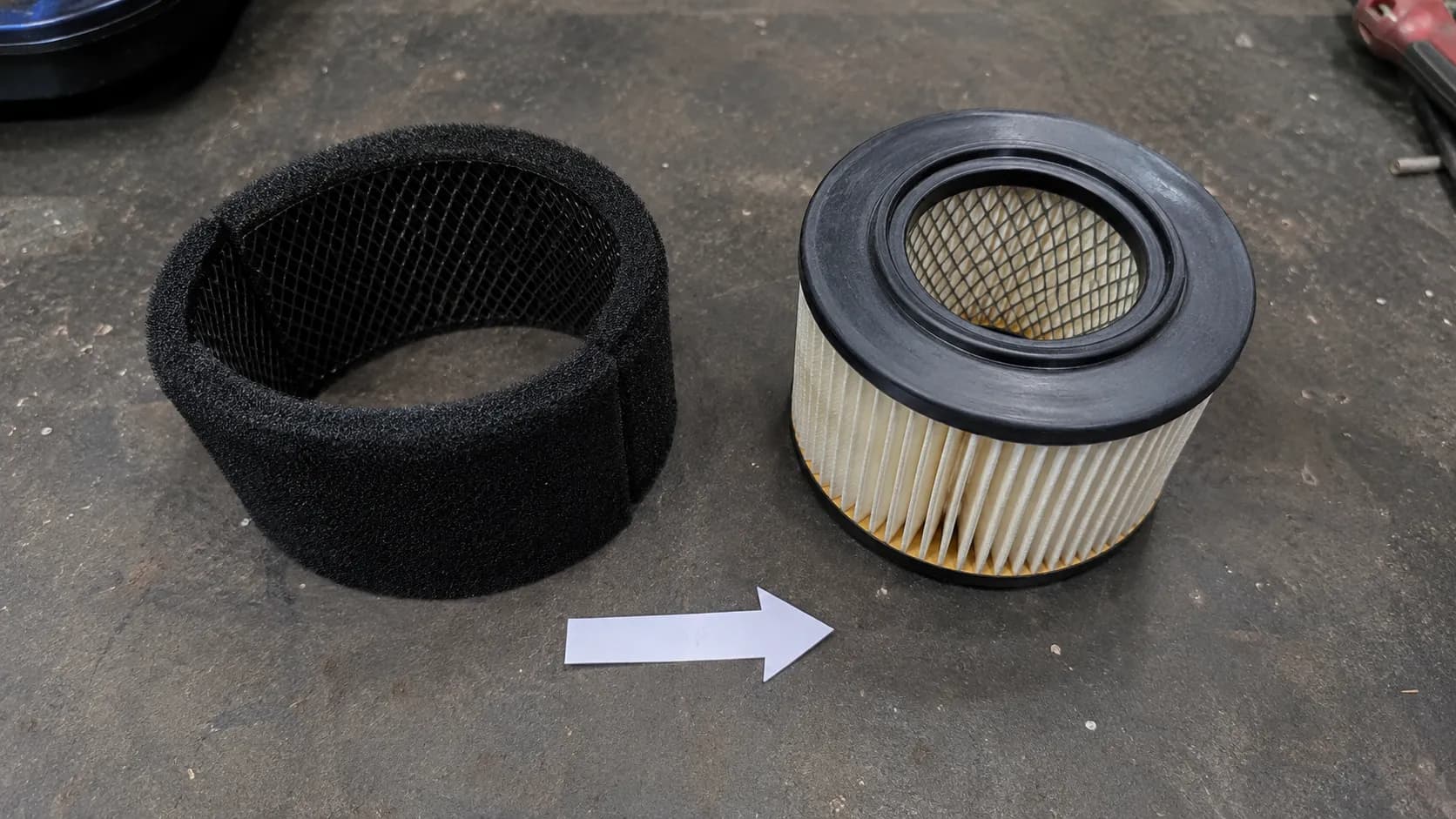
A Briggs & Stratton dual-element filter pairs a foam pre-cleaner over a paper cartridge, and the two pieces are serviced separately on different schedules. The foam pre-cleaner catches the big stuff so the paper core lasts longer, which is the whole point of the design.
Briggs & Stratton specifies replacing the foam pre-cleaner every 25 hours or each season, and the paper cartridge every 100 hours. So you clean and oil the foam often, and swap the paper far less.
Work through it like this:
Remove the knob or cover and lift the assembly out. Keep the pieces oriented as they came apart.
Separate the foam pre-cleaner from the paper cartridge. Slide the foam sleeve off the core.
Wash and re-oil the foam pre-cleaner. Use the same wash, dry, oil, and wring routine as a standalone foam filter. What you should see: barely-damp foam, not dripping.
Tap and inspect the paper cartridge, or replace it. Treat it exactly like a paper-only filter. What you should see: clean pleats that pass light.
Reassemble in the correct orientation and seat the cover. Refit foam over paper, then close up and tighten the knob.
Servicing both elements is really one task inside a full DIY mower tune-up, so it is worth doing the moment you have the housing open.
Watch the mesh-back orientation. If your foam pre-cleaner has a stiff mesh backing, keep the oiled foam face away from the paper. On my V-twin I reassembled it oiled-side-in once, and the paper core wicked oil straight out of the foam and started to darken before I caught it.
Only if your foam has a mesh back. Plenty of pre-cleaners are plain foam and this does not apply. But if yours has that mesh layer, orientation matters, and getting it backwards quietly oils the paper you were trying to protect.
Oil-Soaked Filter? Causes (Tipping & Overfill) and the Fix
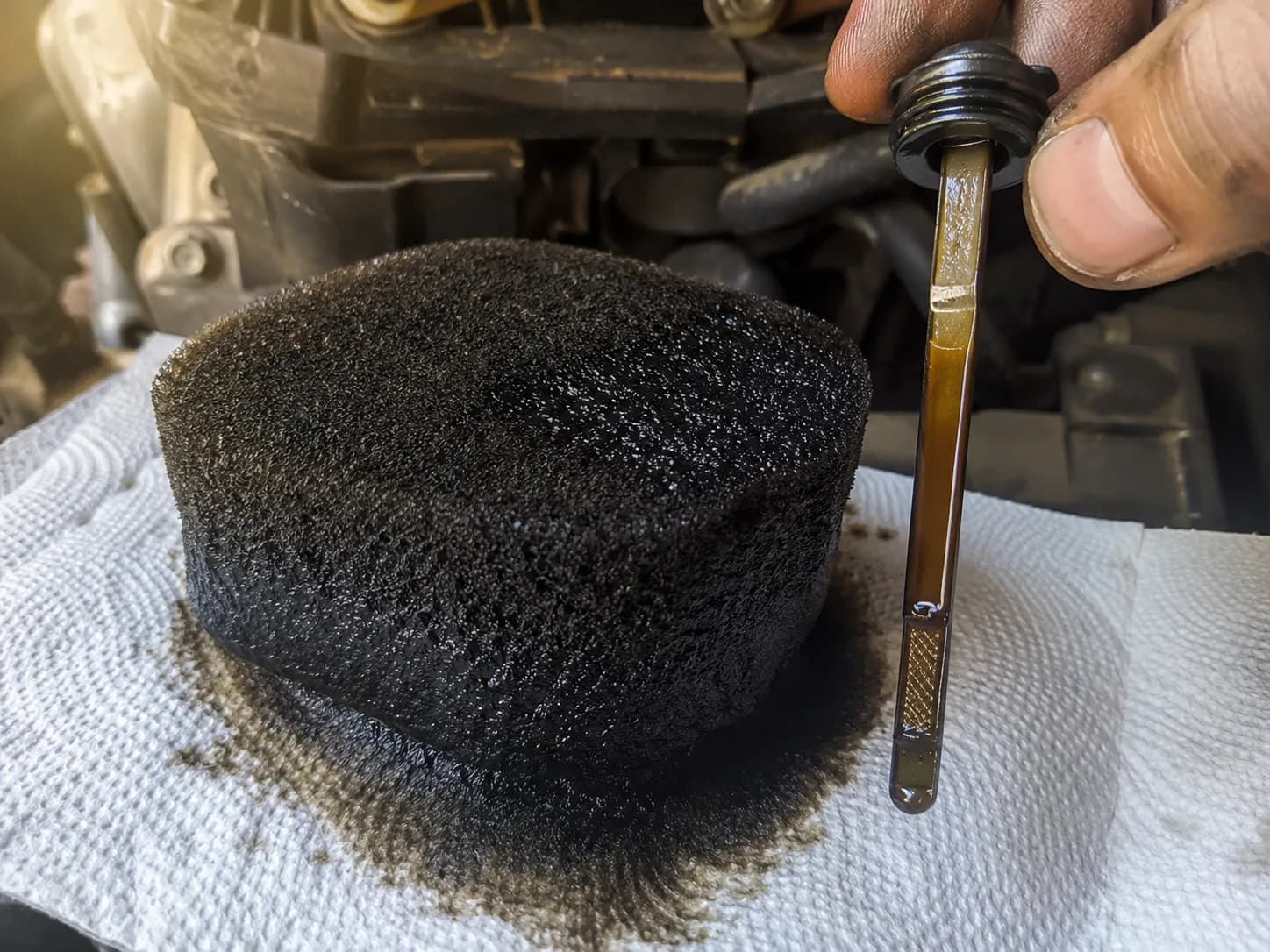
When a Briggs & Stratton air filter turns up soaked in oil, the cause is almost always an overfilled crankcase or a mower tipped carburetor-side down, which forces oil up the crankcase breather and into the air box. The fix is to correct the oil level, clean or replace the soaked element, and change how you store the machine.
As one detailed LawnSite thread lays out, overfilling and tipping are the usual culprits, while worn rings drive the stubborn cases. Here are the causes, ranked by how often they are the real problem:
Likely cause | Why it soaks the filter | Fix |
|---|---|---|
Overfilled crankcase | Excess oil pushes past the breather into the intake | Drain to the dipstick full line |
Tipped carb-side down | Oil runs toward the carburetor and up the vent tube | Store level, tip plug-up only |
Clogged crankcase breather | Blow-by routes oil through the vent into the air box | Clean or replace the breather |
Worn piston rings | High-hour blow-by carries oil up continuously | Compression test, likely rebuild |
Blown head gasket | V-twin failures can pressurize the crankcase | Diagnose and replace the gasket |
Once you know the cause, the fix sequence is short:
Check the oil and drain to the full line. Pull the dipstick and bring an over-full crankcase back to spec.
Replace or clean the soaked element. Oil-soaked foam can sometimes be washed and re-oiled; soaked paper gets replaced.
Clean out the air box. Wipe oil residue from the housing so it does not re-wet the new filter.
Run it a few minutes. Let the engine burn off the last of the residue.
A clogged filter, oily or just dirty, is not harmless. According to PartSelect, a restricted air filter causes hard starting, power loss, and black smoke as the engine runs rich, plus higher fuel use and a fouled plug.
Correct handling and oil level are part of your complete Briggs tune-up, and they prevent most of these symptoms before they start.
I reproduced this one on purpose. After tipping my push mower carburetor-side down to scrape the deck, the filter was oil-soaked within a single mow, and the dipstick was sitting above the full mark.
That pairing, a tip plus a touch of overfill, is the everyday version of this failure.
When to stop swapping filters. If oil keeps reaching the filter after you have corrected the level and stopped tipping the mower, the engine itself is likely worn. At that point the next step is a compression test, not another air filter.
How Often to Clean vs Replace (+ Getting the Right Part)
A Briggs & Stratton air filter should be serviced or replaced every 25 hours of run time or every 3 months, whichever comes first, and sooner in dusty conditions. Foam is reusable so you clean it, paper is a consumable so you replace it, and a dual-element gets foam cleaned often with the paper core swapped around every 100 hours.
Per Briggs & Stratton, the foam interval is 3 months or 25 hours, sooner in dust. To buy the right element, read the engine model number stamped on the housing or blower shroud and match the part to it.
Filter type | Service action | Interval | Rough cost |
|---|---|---|---|
Foam | Wash and re-oil | 25 hr or 3 months, sooner in dust | Cleaning is free; genuine foam runs about $7 to $15 |
Paper | Tap, then replace when spent | 25 hr or 3 months | Genuine paper lasts about 1.5x imitation |
Dual pre-cleaner | Wash and re-oil | 25 hr or each season | About $7 to $15 |
Dual paper cartridge | Replace | Every 100 hr | Varies by engine model |
On the economics, the Briggs & Stratton store guidance is straightforward: foam is reusable and cheap, while paper cannot be cleaned and must be replaced. If you need to match a new element to your engine, our guide to sizing a replacement filter walks through the model-number lookup.
Spring is the time to do this. If the mower sat all winter, service the filter before the first cut, because a season of stored dust and oil residue hardens onto the element.
The spec says 25 hours, but the spec assumes average conditions. Tracking my push mower through a dry, pollen-heavy spring, the foam was visibly loaded and ready to clean closer to 15 hours, not 25, so I cleaned on condition rather than on the clock:
Date (2026) | Engine hours | Filter condition | Action |
|---|---|---|---|
March 21 | 8 | Light dust, airflow fine | Inspected, left in |
April 11 | 15 | Visibly loaded, grey-green | Cleaned and re-oiled |
May 2 | 22 | Lightly loaded again | Cleaned and re-oiled |
May 23 | 30 | Foam softening at one edge | Replaced the element |
Clean is nearly free, but do not gamble on a crumbling filter. Washing foam costs you soap and five minutes. Once the foam starts tearing or a paper cartridge is dark through, replace it rather than nurse it, because a failed filter is far more expensive than the part.
Frequently Asked Questions
How often should you change a Briggs & Stratton air filter?
Service or replace it every 25 hours of use or every 3 months, whichever comes first, and more often in dusty conditions. Foam gets cleaned on that schedule, while paper gets replaced when it is spent.
Can you clean a Briggs paper filter with compressed air?
No. Compressed air ruptures the microscopic pleats and lets unfiltered dirt through, so tap it on a hard surface instead and replace it when it no longer passes light.
Do all Briggs & Stratton air filters need oil?
Only foam does, including the foam pre-cleaner on a dual-element. Paper cartridges must stay dry, because oil clogs the pleats.
Why is my Briggs air filter full of oil?
Usually an overfilled crankcase or a mower tipped carburetor-side down, which forces oil through the breather into the air box. Correct the oil level and handling first, and only suspect worn rings if the oil keeps returning.
Getting the air filter right is the cheapest insurance your mower has. Identify the type, then match the method, foam washed and re-oiled, paper tapped and replaced, and a dual-element done both ways.
Do that every spring and at the 25-hour mark, and learning how to clean a Briggs & Stratton air filter becomes a five-minute habit instead of a repair bill.
Summarize with AI
Keep reading
Related articles
 Maintenance & Seasonal Care
Match a lawn mower tune up kit to your engine: what is inside each kit, OEM vs aftermarket price math, and the right kit by brand for push and riding mowers.
 Maintenance & Seasonal Care
Compare mobile vs drop-off shop for a lawn mower tune up near me: real 2026 price ranges from 12 quotes, the 7 questions to ask, and when to just DIY it.
 Maintenance & Seasonal Care
Match a lawn mower spark plug repair kit to your fault in 30 seconds. 7 kits tested on 9 engines: M14x1.25 sizing, insert lengths, and the $5 boot fix.
 Maintenance & Seasonal Care
Compare lawn mower tune up cost by mower type: $70-$150 push, $150-$280 riding, from 9 real 2026 shop quotes. Plus the same parts for about $18 DIY.
Comments
Moderated for quality. Share a correction, ask a follow-up, or tell us what worked for you - every comment is reviewed before it goes live.